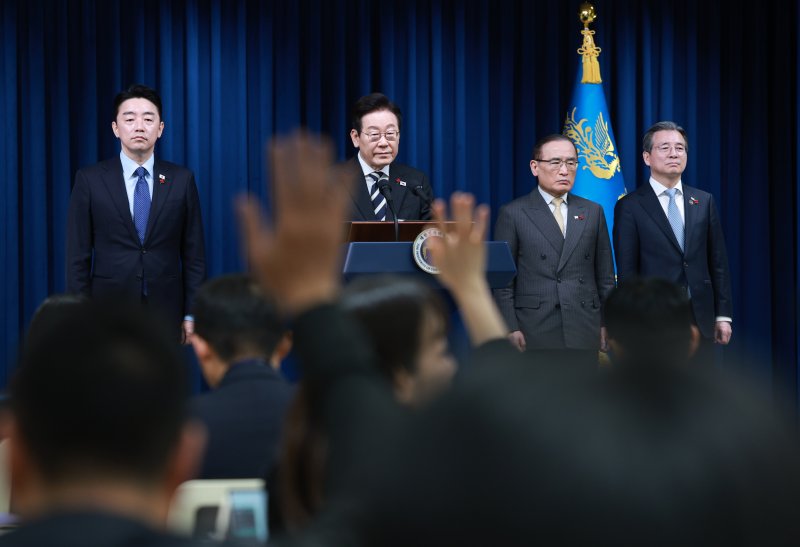
Marking the first anniversary of the December 3 emergency martial law crisis, South Korean President Lee Jae-myung proposed that the South Korean people, who peacefully overcame a democratic crisis, are worthy of the Nobel Peace Prize. He made a significant announcement to designate December 3 as National Sovereignty Day to honor the remarkable courage and actions of the Korean citizens.
Lee: “Citizens demonstrated the greatness of democracy, more than qualified for the award.”
In a special address at the presidential office on the morning of December 3, Lee stated, “As long as the Republic of Korea exists, we will commemorate the preservation of our constitutional order and democracy, using this occasion to reaffirm our commitment to strengthening our democratic values.”
He particularly emphasized that the citizens of South Korea should be awarded the Nobel Peace Prize.
Lee expressed, “I firmly believe that the South Korean people, who peacefully overcame an unprecedented crisis of democracy in world history, are indeed worthy of the Nobel Peace Prize. If the Korean people receive this award for their efforts to revive democracy, restore peace, and demonstrate democracy’s greatness to the world, it will serve as a significant turning point for all nations grappling with conflict and division.”
Following the statement, reporters posed related questions during the Q&A session.
When asked if he would nominate the Korean citizens for the Nobel Peace Prize, Lee replied, “This is my personal opinion. Wouldn’t the will of our people be the most important?” He added, “The Nobel Prize isn’t awarded by our government. It is given by other countries and institutions through objective evaluation, and global public opinion also matters. I hope my remarks will spark discussions about the feasibility and validity of this idea.”
He continued, “I believe South Korean citizens fit the qualifications for the award the best. If the martial law had succeeded from the perspective of those who initiated it, it would have resulted in violent outcomes and non-peaceful events. The citizens beautifully thwarted the martial law with their bare hands, preserving peace. This isn’t just a matter for South Korea. I believe it has given great hope to democratic citizens worldwide.”
“Designating National Sovereignty Day requires legislative action… Extensive debate expected”
The discussion about the Nobel Peace Prize led to questions regarding the designation of National Sovereignty Day.
Lee noted, “In our history, there have been instances where we upheld national sovereignty. There have been successes and failures, and sometimes those successes have been long delayed.” He explained, “It is not common to have an experience where citizens have triumphed in the most beautiful, peaceful, and just manner through legal processes.”
He further suggested, “To ensure that future generations can remember and experience this historical record, I am considering designating this day as the day the Revolution of Light began, the day true national sovereignty was realized.” He emphasized, “It is important to establish it as a legal holiday so that citizens can reflect on it and reaffirm their commitment at least once a year. It is certainly worth it.”
He also added, “The administration cannot unilaterally decide this. It must go through National Assembly legislation, and there will be extensive debate in that process.” He concluded, “Ultimately, I believe the decision will be made according to the will of the people.”
Meanwhile, the Nobel Prize is awarded in five categories: Physics, Chemistry, Physiology or Medicine, Literature, and Peace. The Economic Sciences Prize was added in 1969. Among these, the Peace Prize is selected by a committee of five elected by the Norwegian Parliament.
While the Nobel Prize is typically awarded to living individuals, the Peace Prize can be awarded to organizations or groups.