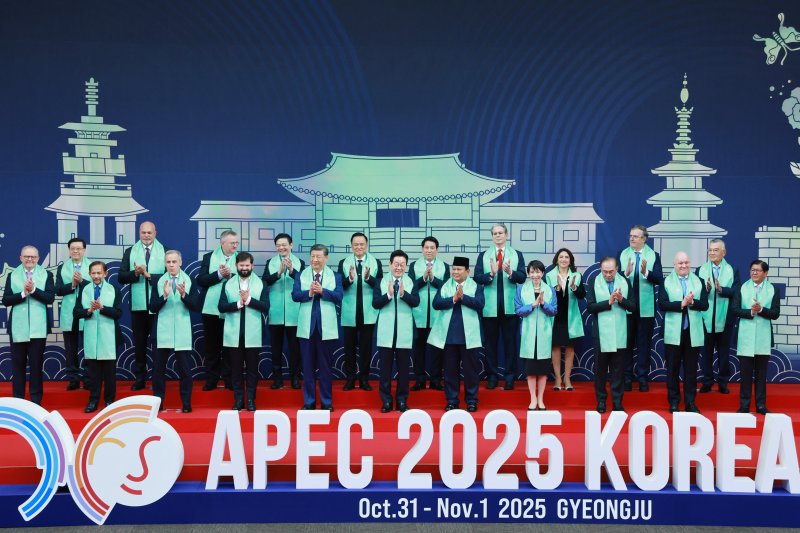
South Korean President Lee Jae-myung concluded the six-day “Diplomatic Super Week” on November 2 with the APEC summit. Assessments are emerging that South Korean diplomacy achieved both practical benefits and balance through a series of bilateral talks with the U.S., China, and Japan. As the host country of APEC, South Korea successfully navigated the Gyeongju Declaration amid U.S.-China tensions. The revival of cooperation with China, focusing on economic and social issues, is seen as a major achievement.
The South Korean Presidential Dffice reported that during the South Korea-China summit on November 1 at the National Gyeongju Museum, President Lee and Chinese President Xi Jinping reaffirmed their commitment to restoring relations, describing their countries as inseparable, cooperative partners. Xi expressed joy at his first visit to South Korea in 11 years, while Lee said he had been eager for this face-to-face meeting. The leaders agreed on practical cooperation measures, including supply chain stability, cultural and youth exchanges, and economic collaboration.
At the banquet, Xi quoted a poem by Silla-era scholar Choi Chi-won, noting the enduring friendship between China and South Korea. Lee responded that the relationship between the two countries must be passed on to future generations. The presence of business and cultural figures signaled improving bilateral relations. Attendees included Samsung Electronics Chairman Lee Jae Yong, SK Group Chairman Chey Tae-won, Hyundai Motor Group Chairman Chung Eui-sun, and LG Group Chairman Koo Kwang-mo.
Earlier, on October 29, the South Korea-U.S. summit yielded significant progress in economic and security areas. Lee and U.S. President Donald Trump agreed on a 350 billion USD investment framework, emphasizing commercial rationality. They capped South Korea’s annual cash investment at 20 billion USD to prevent full prepayment demands and reportedly specified semiconductor tariff levels in the fact sheet.
The leaders also agreed on the need for nuclear-powered submarines and to begin follow-up talks. National Security Advisor Wi Sung-lak highlighted U.S. willingness to cooperate on strategic issues as a key achievement in modernizing the alliance.
However, no meeting occurred between North Korean leader Kim Jong Un and Trump during this week. Trump expressed openness to renewed dialogue with North Korea and his hope to meet Kim on his next visit. Lee pledged to facilitate conditions for peace on the Korean Peninsula.
The South Korea-Japan summit focused on future cooperation without dwelling on historical issues. Japanese Prime Minister Sanae Takaichi notably emphasized trilateral cooperation among Japan, South Korea, and the U.S., mentioning South Korea before the U.S.
The Gyeongju summit concluded with the adoption of the Gyeongju Declaration. South Korea proposed a compromise to evaluate ministerial meeting outcomes instead of explicitly supporting the WTO and multilateralism, effectively mediating between U.S. protectionism and Chinese multilateralism.
Political and diplomatic circles praise South Korea’s balanced diplomacy, securing benefits in U.S. talks, restoring China relations, and maintaining trust with Japan. The Gyeongju Declaration is seen as reviving multilateral cooperation amid U.S.-China tensions. Challenges remain, including formalizing agreements and obtaining parliamentary approval, with maintaining balance crucial if U.S.-China conflicts resurface.