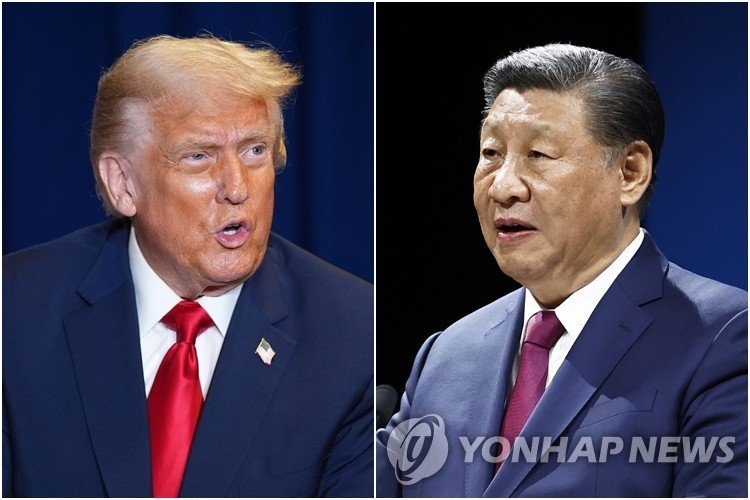
Although trade tensions between the U.S. and China are intensifying ahead of a presidential summit, both sides are keeping communication channels open. U.S. President Donald Trump, who had previously threatened to impose a 100% tariff on Chinese goods, adopted a more conciliatory tone on Sunday.
In contrast, U.S. Trade Representative Jamieson Greer criticized China for postponing talks, contending that Beijing’s attempts at a “power grab” would not be tolerated.
Trump took to Truth Social, stating, “The U.S.A. wants to help China, not hurt it.” He wrote, “Don’t worry about China, it will all be fine,” adding, “Highly respected President Xi just had a bad moment. He doesn’t want Depression for his country, and neither do I.”
Trump’s remarks came just two days after the U.S. announced on Friday that it would impose an additional 100% tariff on Chinese products next month, following China’s tightening of rare earth export controls. The two countries have been locked in a trade war since April, with tariffs exceeding 100% exchanged between them. While high-level negotiations had temporarily eased tensions, recent developments suggest a renewed escalation of the conflict.
Speaking to reporters aboard Air Force One en route to Israel, Trump expressed optimism about U.S.-China relations, highlighting his “good relationship” with Xi. When asked if he still planned to impose the 100% additional tariff on China starting November 1, Trump replied, “For now, yes,” but added, “Let’s see what happens.”
Greer also emphasized that dialogue channels remain open. In a Fox News interview on Sunday, he stated that Trump maintains a good personal relationship with Xi, and that communication lines between both sides are open. Greer expressed hope for a return to the stability of a week ago. He noted that both leaders might soon be in Asia, providing a potential opportunity for a meeting, He added that, as always, Trump is ready to talk if both sides are willing.
However, Greer strongly criticized China’s rare earth export control measures. He claimed that the U.S. received no prior notification and that China postponed a requested phone call once the U.S. became aware of the issue – contradicting China’s claim that it had informed relevant countries through diplomatic channels.
Greer asserted that the U.S. would not tolerate China’s attempt to control global technology exports through these measures. He suggested that China may now realize it overstepped, pointing out that Beijing violated a May agreement to resume rare earth exports and reduce tariffs. Regarding Trump’s threat of 100% tariffs on Chinese products from November 1, Greer noted that China still has an opportunity to de-escalate the situation.