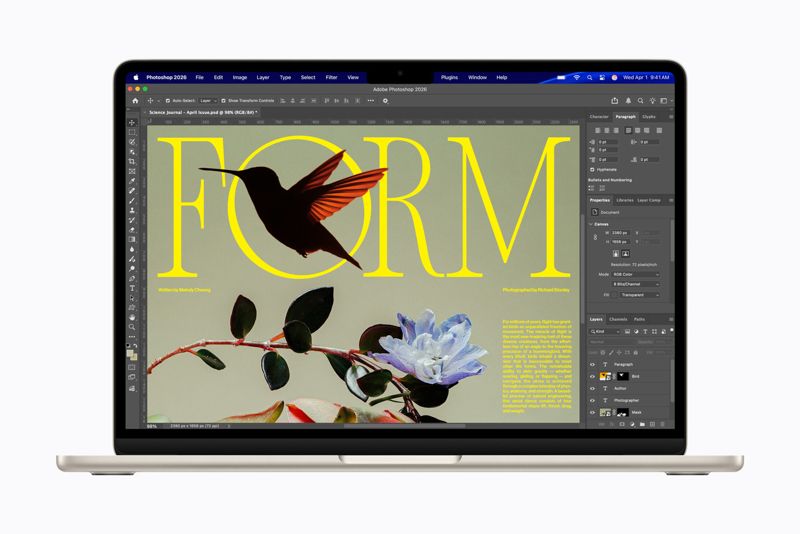
Apple has introduced its latest MacBook Air powered by the M5 chip. While the starting price has seen a 100 USD bump, the company compensates for the hike by doubling the base storage and significantly enhancing AI capabilities.
According to industry insiders and tech publication Engadget on March 5, the 13-inch MacBook Air M5 will start at 1.79 million KRW (about 1,223 USD), with the 15-inch model beginning at 2.09 million KRW (about 1,427 USD). Pre-orders opened on March 4, with the official launch slated for March 11.
The new MacBook Air M5 comes with a base capacity of 512GB, twice that of its predecessor. In a first for the MacBook line, users can now opt for up to 4TB of storage, catering to power users and creative professionals alike.
Memory speed has also improved. Apple claims the M5’s integrated memory outpaces the M4 by 28%, while the new solid-state drive (SSD) delivers up to twice the file access speed. Notably, AI performance has quadrupled, potentially decreasing 3D rendering times in Blender by up to 50%.
The MacBook Air M5 introduces the N1 wireless networking chip, supporting next-gen standards like Wi-Fi 7 and Bluetooth 6.
Battery life remains unchanged from the previous model, with Apple claiming the device will provide up to 18 hours of video streaming and 15 hours of wireless web browsing.
The design, display, and audio components also remain identical to the previous generation. The 13-inch model measures 11.97×8.46×0.44 inches, while the 15-inch version comes in at 13.4×9.35×0.45 inches, maintaining its signature ultra-thin and lightweight profile. As before, port selection is limited to two Thunderbolt 4 ports and a headphone jack. Color options include Sky Blue, Midnight, Starlight, and Silver.
Both the 13-inch and 15-inch models sport a Liquid Retina LED panel with 224 pixels per inch, capable of a peak brightness of 500 nits.
Engadget notes that while the price hike could justify more visible changes, the M5 chip’s AI prowess, offering up to four times faster processing for AI tasks, will deliver noticeable performance gains even for casual AI users.