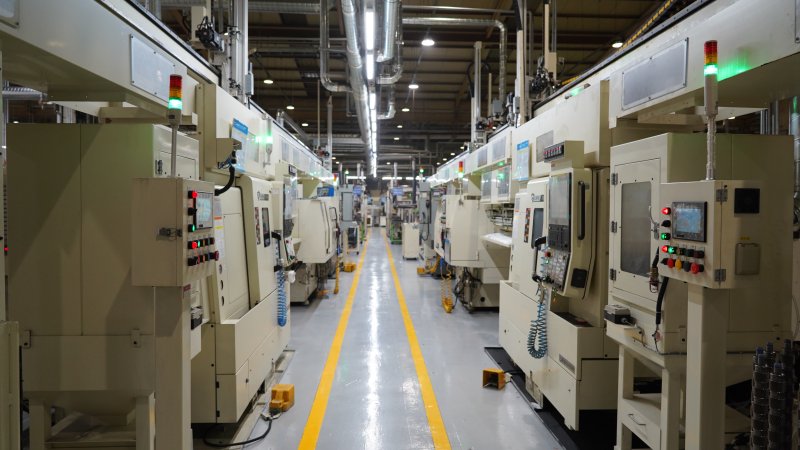
“It is a space where internal combustion engines and future mobility coexist.”
After a roughly one-hour flight from Gimpo Airport to Sacheon Airport and a 15-minute drive, the headquarters of Daedong Gear came into view. Visiiting the site on February 4, the 130,000-square-meter Daedong Gear headquarters housed Plant 1 and Plant 2. Daedong Gear, a subsidiary of agricultural machinery giant Daedong, reported impressive sales of 257 billion KRW (approximately 177.30 million USD) in 2024.
Plant 1 mainly produces components used in future mobility such as electric vehicles and hybrid vehicles, while Plant 2 focuses on components used in internal-combustion engines. Entering Plant 2 first, many employees at each process were busy assembling tractor transmissions.
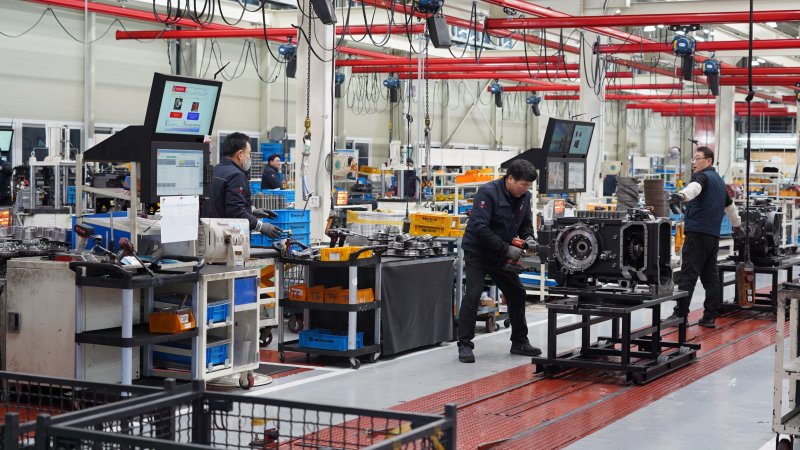
Often referred to as the “heart of the tractor,” these transmissions weigh a hefty 1.5 tons each. Production Team Leader Kang Dae-sik revealed that the second factory’s two lines churn out an impressive 30,000 tractor transmissions annually.
Inside Line 1 of Plant 2, the assembly of differential gears was in full swing. The differential gear distributes power evenly to the tractor’s left and right wheels. The process then moved on to brake assembly and rear axle coupling.
Once assembled, the completed tractor transmissions undergo a rigorous testing process. They are carefully submerged in water using a crane for hydraulic testing, followed by motor and vision inspections.
The vision inspection process is particularly noteworthy. Automated guided vehicles (AGVs) transport the transmissions to a station where robotic arms capture images from various angles.
“Our robotic arm system performs a 360-degree inspection, taking photos to assess quality,” Kang explained. “Since implementing this vision inspection process in the latter half of last year, we’ve seen an impressive 80% reduction in defect rates.”
Plant 1 presented a completely different scene from Plant 2. Almost no employees were visible inside the facility. Powertrain Development Team Leader Hwang Seong-hyun noted, “Plant 1, which produces parts for electric vehicles and hybrid vehicles, is fully automated. We have reduced our workforce needs from two workers per line to just 0.5, thanks to these advancements.”
At Plant 1, Daedong Gear produces sun gears for hybrid vehicles and output shafts for electric vehicles. Sun gears play a crucial role in efficiently distributing power between a hybrid vehicle’s engine and motor, while output shafts transmit the substantial rotational force from the reduction gear to the wheels in electric vehicles.
To meet the steadily growing demand for output shafts, Hwang outlined plans to quadruple the factory’s output shaft production. “We are expanding the current one line producing 300,000 units annually to four lines with a total capacity of 1.2 million units,” he stated.
Daedong Gear aims to diversifyits business scope into robotics components. CEO Seo Jong-hwan revealed, “We have already developed reduction gears for robots, and plan to enter the actuator field, combining reduction gears with motors, in the medium to long term.” Seo expressed confidence that this strategic focus on future mobility and robotic parts will help the company achieve its ambitious goal of 1 trillion KRW (approximately 690 million USD) in sales by 2030.