On December 8, business leaders from South Korea and Japan convened to collaborate on investments in key future industries, including artificial intelligence (AI), semiconductors, and energy, as well as to establish joint supply chains. The recent visit of SoftBank Group Chairman Masayoshi Son to Korea has accelerated efforts to train AI semiconductor design specialists, signaling a broader move towards strengthening economic ties between the two nations.
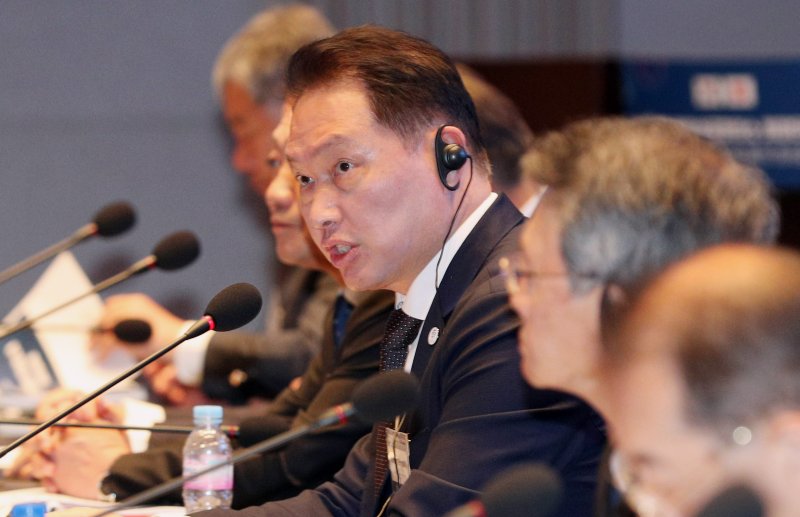
Choi Tae-won, Chairman of the Korea Chamber of Commerce and Industry, co-hosted the 14th Korea-Japan Chamber of Commerce and Industry meeting with Ken Kobayashi, Chairman of the Japan Chamber of Commerce and Industry, at the Shilla Hotel in Jeju. They issued a joint statement commemorating the 60th anniversary of diplomatic normalization, emphasizing cooperation in three key future industries. This collaboration comes at a crucial time, as both countries face increasing U.S. tariff risks, ongoing U.S.-China tensions, and heightened China-Japan frictions.
In his opening remarks, Choi emphasized the need for concrete action, stating, “Our two nations must now move beyond mere cooperation to design our shared future through solidarity and collaboration.”
The joint statement outlines plans for collaboration in future industries like AI, semiconductors, and energy, joint efforts to address low birth rates and aging populations, and initiatives to expand cultural exchanges.
Both parties acknowledged these sectors as vital to their national competitiveness and agreed to foster stable investment environments and joint supply chains. They proposed leveraging mutual strengths in AI and semiconductors, such as physical AI cooperation and joint multimodal AI platform development. The leaders also recognized the need for a cross-border startup ecosystem to overcome individual country limitations.
Additionally, they committed to tackling shared demographic challenges of low birth rates and population decline. As government talks begin, the private sector plans to explore practical cooperation, including policy and research exchanges. This builds on previous agreements to address various social issues, including demographic challenges, balanced growth, agriculture, disaster prevention, and suicide prevention.
The chambers held a special discussion to elevate their cooperation to a true economic partnership. Moderated by Professor Sang-jun Park of Waseda University, the panel included experts from both countries who emphasized the need for Korea and Japan to become “rule setters” rather than “rule takers” in the face of global industrial and trade restructuring. They highlighted the potential for expanding their joint market through closer economic ties.
The meeting brought together 16 Korean business leaders, including heads of regional chambers and executives from major corporations like Samsung and SK Group. The Japanese delegation included six prominent business figures, representing various regional chambers and major companies.
The next Korea-Japan Chamber of Commerce and Industry meeting is scheduled to take place in Sendai, Japan, next year.