Despite trade uncertainties such as high tariffs originating from the U.S., South Korea’s exports are projected to hit an all-time high this year, driven by the diversification of export markets and products.
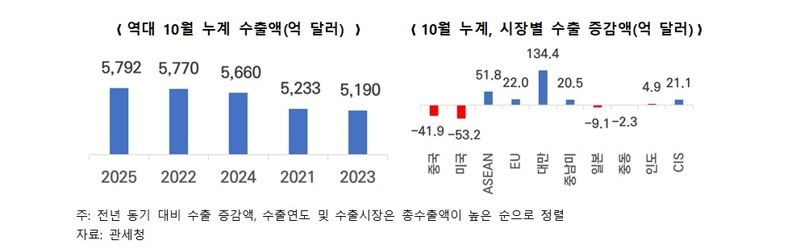
According to a report released on Thursday by the Korea Trade-Investment Promotion Agency (KOTRA), titled “Analysis of U.S. Tariff Impact and Export Market Diversification Trends,” cumulative exports reached 579.2 billion USD by the end of October, marking a 2.3% increase from the previous year.
This growth is attributed to domestic companies’ efforts to diversify their markets. The report shows significant increases in exports to various regions, with ASEAN (Association of Southeast Asian Nations) up by 5.18 billion USD (5.5%), the European Union by 2.12 billion USD (3.9%), and Taiwan by 13.53 billion USD (51.0%). These gains have helped offset declines in exports to the U.S. (5.32 billion USD) and China (4.19 billion USD) resulting from tariffs and trade tensions.
As a result, the export market concentration index eased from 896 to 791 between January and September. The share of exports to the U.S. decreased from 18.9% in January to 17.2%, with alternative markets in the Global South, such as ASEAN and Taiwan, filling the gap.
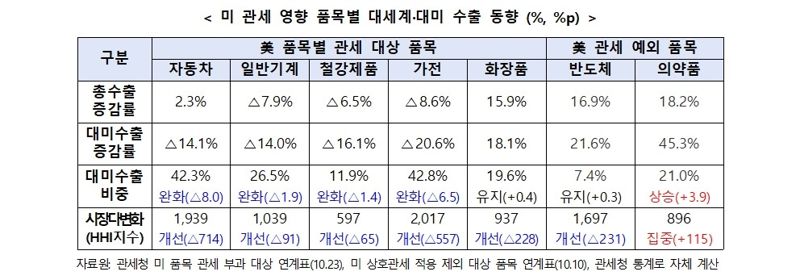
In particular, some companies exporting products subject to high U.S. tariffs have swiftly pursued market diversification strategies. For example, the share of U.S.-bound exports for automobiles and steel, which faced specific tariffs, dropped from 34% in January to 30% by September as firms expanded into alternative markets.
In the automotive sector, exports were diversified to the EU and Commonwealth of Independent States (CIS) markets, while also diversifying their product range to include electric vehicles and used cars. Despite a 14.1% drop in exports to the U.S., total exports in this sector increased by 2.3%. Similar trends were observed in general machinery and steel products.
K-beauty products, a representative Korean consumer goods, experienced simultaneous growth in total exports and market diversification, benefiting from a positive cycle between K-culture and industry. Despite U.S. tariffs on aluminum content in cosmetic containers implemented in August, South Korea maintained its top market share in the U.S., with exports rising 18.1% to 1.7 billion USD from January to September.
Exports of semiconductors and pharmaceuticals, exempt from high U.S. tariffs, also achieved success in both export performance and market diversification. This growth was driven by increasing global demand and enhanced competitiveness of South Korean companies. Semiconductor exports to the U.S. surged by 22% to 8.9 billion USD, with notable market diversification to ASEAN and Taiwan.
Among the top five consumer goods, pharmaceutical exports, which are expected to surpass 10 billion USD this year following food and cosmetics, also showed a strong performance. K-pharmaceutical exports, which gained recognition during the pandemic, avoided the impact of high tariffs, increasing by 45% to the U.S. and 18% globally.
KOTRA President Kang Kyung-seong stated, “While the trade environment is rapidly evolving due to rising protectionism and nationalism, we can leverage this as an opportunity for export diversification to accelerate our ascent into the top five global exporters. We are committed to diversifying markets with a focus on the Global South, expanding K-consumer goods and AI products, and increasing the number of exporting companies.”