OpenAI announced on March 6 that it had unvelied GPT-5.4, its latest artificial intelligence (AI) frontier model, designed for professional tasks.
GPT-5.4 integrates reasoning capabilities, coding performance, and agent-based workflows into a single, unified model across ChatGPT, the application programming interface (API), and Codex.
In particular, by incorporating the industry-leading coding capabilities of GPT-5.3-Codex, the company explained that it has significantly improved the use of various tools and software in professional environments such as spreadsheets, presentations, and document creation. Consequently, the model enables users to tackle complex real-world tasks with greater accuracy and efficiency, while reducing repetitive work.
Performance benchmarks reveal notable improvements in GPT-5.4. In the GDPval benchmark, which assesses AI agents’ ability to perform knowledge-based tasks, GPT-5.4 matched or exceeded industry experts in 83% of overall task comparisons, a significant leap from GPT-5.2’s 71.0%.
During development, OpenAI focused on enhancing spreadsheet modeling, presentation, and document generation and editing capabilities. An internal benchmark simulating tasks typically performed by junior investment banking analysts showed GPT-5.4 scoring an average of 87.5%, far outperforming GPT-5.2’s 68.4%.
GPT-5.4 is OpenAI’s first general-purpose model with built-in computer-use capabilities. In Codex and API environments, the AI agent can manipulate software and navigate multiple applications to execute complex workflows. Supporting up to 1 million tokens in context, GPT-5.4 is well-suited for building agent systems that plan, execute, and validate extended tasks.
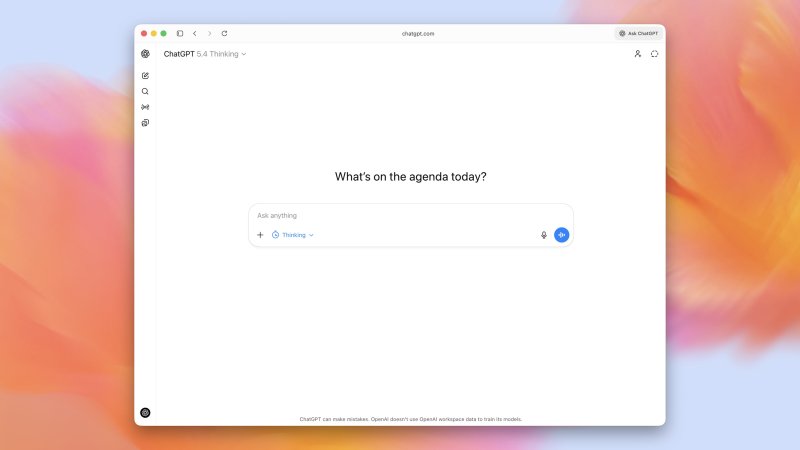
Provided in ChatGPT, where users can select GPT-5.4 Thinking, the model introduces a novel approach to working. The model presents a work plan before generating responses, allowing users to guide the response generation process. This feature helps users achieve desired outcomes more quickly without having to repeat additional conversations.
The model also boasts enhanced web-based research capabilities, providing more accurate and consistent answers to complex questions requiring information synthesis from multiple sources.
To operate efficiently in expansive tool environments, GPT-5.4 incorporates a tool search function. This allows agents to locate and utilize necessary tools more accurately within environments connected to various tools and connectors, while reducing token usage and response delays.
An OpenAI spokesperson stated, “GPT-5.4 is our most efficient reasoning model to date, significantly reducing the number of tokens needed for problem-solving compared to GPT-5.2. We anticipate that businesses and professionals will be able to perform complex tasks more quickly and accurately, and that new AI agent-driven work methods will become increasingly prevalent.”