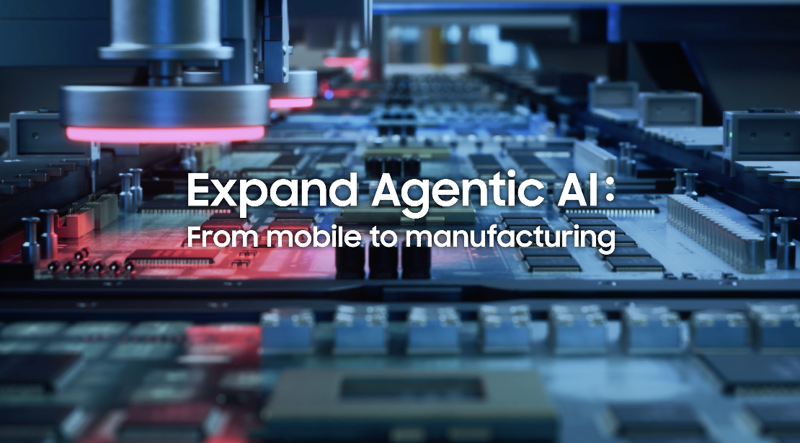
Samsung Electronics has declared its plan to convert all its global manufacturing plants into AI autonomous factories by 2030. These AI autonomous facilities will integrate artificial intelligence throughout the entire production process.
The company intends to revolutionize quality control and productivity across its global manufacturing network. It plans to implement digital twin-based simulations throughout the total manufacturing process from material receipt to production and shipment, while using AI agents for quality control, production, and logistics to enable data-driven analysis and preemptive validation. Furthermore, Samsung will also extend AI applications to environmental and safety monitoring to detect potential hazards in advance and prevent accident before they occur, thereby elevating workplace safety standards.
On March 1, Lee Young-soo, Executive Vice President and head of Samsung Electronics’ Production Technology Research Institute, stated, “The future of manufacturing innovation goes beyond simple automation. The key lies in creating autonomous production environments where AI understands the site and independently makes optimal decisions.” He added, “We are committed to becoming a global leader in AI-driven manufacturing innovation.”
Leveraging its AI expertise from its mobile division, Samsung Electronics plans to apply Agentic AI introduced with the Galaxy S26 to its manufacturing processes. Agentic AI refers to artificial intelligence capable of autonomously planning and executing actions to achieve set objectives.
Through these AI agents, Samsung plans to intelligentize its overall production, equipment management, repairs, and logistics, thereby strengthening the foundation for complete on-site autonomy.
In its transition from automation to full autonomy, Samsung Electronics is gradually introducing humanoid manufacturing robots across all production processes. Samsung aims to create optimized manufacturing environments by integrating AI with specialized robots. These include operating bots for managing production lines and equipment, logistics bots for material handling, and assembly bots for performing intricate assembly tasks.
For high-risk environments such as high temperature or high-noise infrastructure areas where human workers face challenges, the company plans to deploy digital twin-based environmental safety bots, which will enhance workplace safety and systematically reduce on-site risks.
Samsung Electronics is set to unveil its industrial AI strategy and showcase its vision for digital twin-based manufacturing innovation at MWC26, the world’s premier mobile technology exhibition in Barcelona, Spain.
During MWC26, Samsung will present its “Strategy for Strengthening Governance in Response to Expanding AI Autonomy” at the Samsung Mobile Business Summit (SMBS). This aligns with the growing trend of Agentic AI adoption across various industries, including manufacturing.
As industrial AI applications continue to expand, Samsung Electronics recognizes that true autonomy, where AI understands and makes optimal decisions independently, is essential. Consequently, the company will incorporate robust safety measures from the design stage to ensure the responsible and trustworthy deployment of industrial AI for its customers and partners.
Celebrating its 10th anniversary this year, the SMBS is an exclusive event where Samsung shares its B2B strategies and latest technological developments with key enterprise customers and partners. The summit serves as a platform to explore collaborative opportunities and identify new business prospects in the industrial sector.