Samsung Electronics is set to establish a joint research and development (R&D) framework with Applied Materials (AMAT), the world’s largest semiconductor equipment manufacturer, to bolster its competitiveness in ultra-fine processes below 2 nanometers. The collaboration aims to enhance both yield rates and performance of next-generation Gate-All-Around (GAA) processes, starting from the equipment stage. Samsung will be the inaugural partner in AMAT’s Epic Center, a semiconductor R&D hub in Silicon Valley backed by a 5 billion USD investment. AMAT plans to maintain close cooperation across foundry and memory sectors through advanced semiconductor process technology and manufacturing equipment.
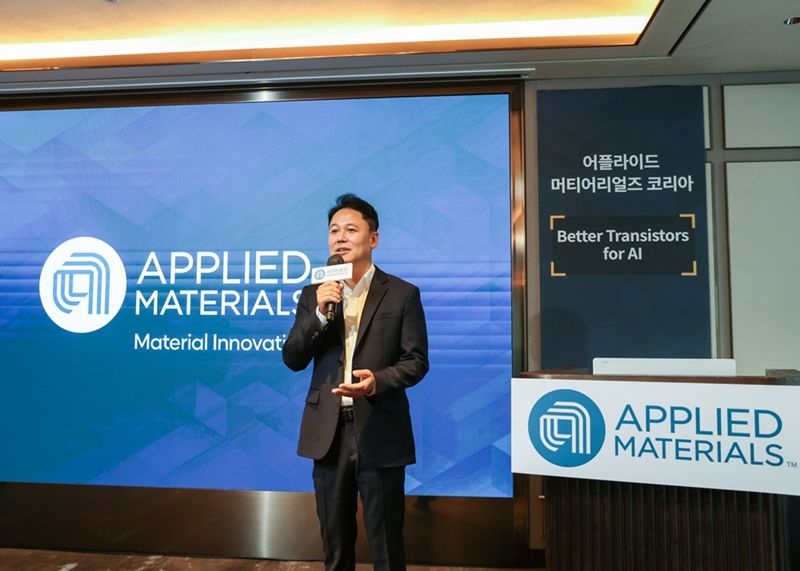
On February 12, Park Kwang-seon, CEO of AMAT Korea, announced at the press conference, “Samsung Electronics has joined as the first funding member of our semiconductor R&D collaboration center, the Epic Center. This is just the beginning, and diverse customers will participate to accelerate technology development.”
Established in 1967, AMAT is the world’s leading semiconductor equipment manufacturer. They produce high-performance equipment for all stages of semiconductor manufacturing, including deposition, etching, rapid thermal processing, ion implantation, measurement, inspection, and packaging. Global semiconductor giants such as Samsung Electronics, SK Hynix, and TSMC are all AMAT clients. The Epic Center is expected to serve as a testbed for jointly validating core technologies for sub-2 nanometer processes, including next-generation GAA transistors. With the surge in AI semiconductor demand and technical challenges rising for both logic and memory, the goal is to establish early collaboration among design, process, and equipment.
Samsung’s role as the first funding member of the Epic Center indicates its commitment to joint process optimization from the initial stages. AMAT showcased three new products targeting sub-2 nanometer processes, raising expectations for technological advancements. The Applied Producer Viva Radical Processing system specializes in using ultra-pure radicals to flatten GAA silicon nanosheet surfaces. Nanosheets are made of ultra-thin silicon layers just a few nanometers wide, and are highly sensitive to atomic-level imperfections that can significantly impact chip performance. This system is crucial for enhancing electron mobility and improving energy efficiency.
The Sym3 Z Magnum etching system incorporates second-generation pulse voltage technology (PVT2), allowing independent adjustment of ion angles and energy. This capability enables the production of uniform nanosheets, faster switching speeds, and high-quality epitaxy, thereby enhancing transistor speed and overall chip performance. Additionally, the Centris Spectral Molybdenum Atomic Layer Deposition (ALD) system replaces conventional tungsten contacts with molybdenum, reducing contact resistance by up to 15%. This advancement significantly boosts chip performance and energy efficiency.
Through these technologies, AMAT aims to advance the 2-nanometer GAA process in partnership with Samsung Electronics while exploring opportunities in next-generation memory. At SEMICON Korea, Samsung unveiled its next-generation roadmap, including HBM4E, HBM5, Custom HBM, and zHBM, following HBM4, intensifying its strategy for AI-customized memory. Regarding this, Jang Dae-hyun, Senior Director at AMAT Korea, stated, “At the Epic Center, we plan to collaborate with Samsung Electronics on advanced node development. We are open to exploring opportunities in next-generation memory as well.”