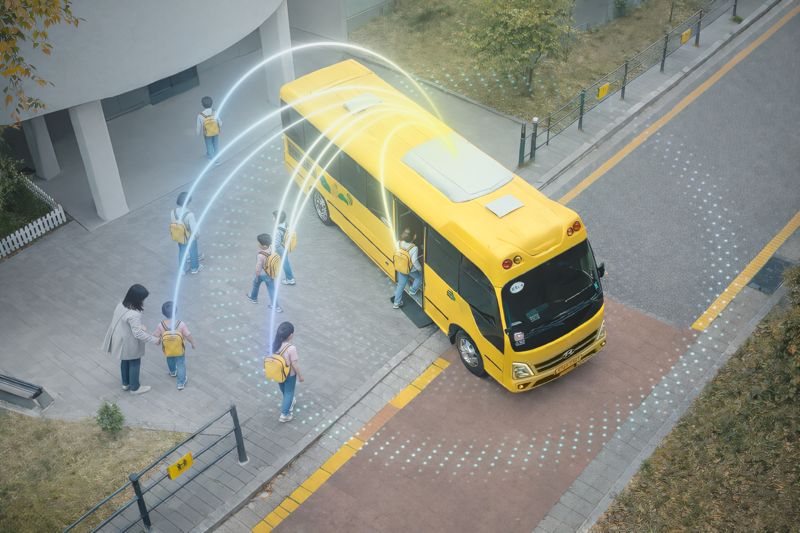
Hyundai Motor and Kia announced on Thursday that they have developed the world’s first Vision Pulse technology, which utilizes ultra-wideband (UWB) radio waves to detect obstacles around vehicles in real-time.
This technology boasts impressive capabilities. UWB’s minimal interference and superior diffraction and penetration properties allow it to precisely identify objects within a 100-meter radius at complex intersections. The margin of error is within 10 centimeters. According to Hyundai Motor Group, the technology maintains a detection performance of over 99% even at night or in bad weather and supports high-speed communication at the 1 to 5 millisecond level, making it highly effective for real-time safety management.
UWB modules are more cost-effective than alternatives like lidar and radar. Vehicles already equipped with UWB technology do not require additional hardware installation. To enhance the system’s versatility, Hyundai and Kia have developed an algorithm that accurately predicts the position of fast-moving objects near the vehicle.
However, for this technology to function other vehicles, motorcycles, bicycles, and pedestrians must also be equipped with UWB modules. The technology calculates positions by measuring signal exchange times between UWB modules.
The potential applications of Vision Pulse extend far beyond driver assistance. In industrial settings, it could reduce workplace accidents by preventing collisions between workers and machinery. During natural disasters, the technology could provide rescue teams with precise locations of trapped individuals, potentially saving lives.
Hyundai and Kia are already putting Vision Pulse to the test. Since last year, they have been running a pilot project at Kia’s Purpose-Built Vehicle (PBV) conversion center, using the technology to prevent forklift-worker collisions. Plans are also in place to validate the system at Busan Port’s terminal and surrounding areas.
A spokesperson for Hyundai Motor and Kia emphasized that Vision Pulse embodies the companies’ commitment to prioritizing safety. They expressed confidence that this technology will contribute to “progress for humanity” across various fields, transcending industry boundaries.