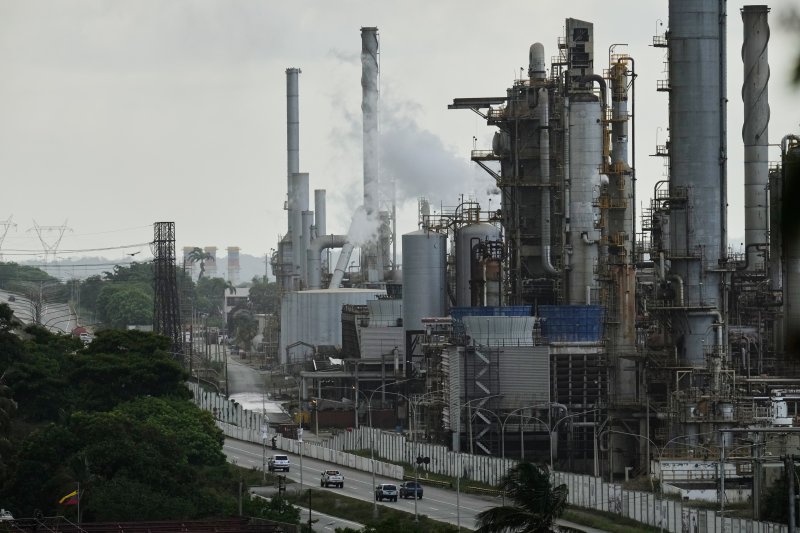
Global oil prices climbed over 1% on Monday.
The price hike was fueled by concerns over the future of Venezuela, a founding member of the Organization of Petroleum Exporting Countries (OPEC) and home to the world’s largest oil reserves.
However, analysts suggest that this market anxiety will be short-lived, given Venezuela’s diminished influence on the global oil market due to years of underinvestment stemming from prolonged dictatorship and corruption.
As Venezuelan President Nicolás Maduro appeared in a New York court following his arrest by U.S. authorities, international oil prices saw a significant uptick.
Brent crude, the global oil benchmark, rose 0.90 USD (1.48%) to 61.65 USD per barrel for March delivery.
The U.S. benchmark, West Texas Intermediate (WTI), saw its February contract jump $0.94 (1.64%) to 58.26 USD per barrel.
According to the U.S. Energy Information Administration (EIA), Venezuela, an OPEC founding member, holds the world’s largest oil reserves with approximately 303 billion barrels – roughly 17% of global reserves.
However, Venezuela’s oil industry has been on a downward spiral since the nationalization efforts under former President Hugo Chávez.
CNBC, citing analysis from energy consultancy Kpler, reported that Venezuela’s oil production has plummeted since peaking at around 3.5 million barrels per day in the late 1990s. Kpler estimates current production at a mere 800,000 barrels per day.
Chevron remains the sole major U.S. oil company operating in Venezuela, though its export volumes are negligible. Kpler data shows Chevron’s oil exports from Venezuela averaged about 140,000 barrels per day at the end of the fourth quarter last year.
With U.S. President Donald Trump citing oil as a key factor in the Venezuelan intervention, the impact on the oil market remains uncertain.
Daan Struyven, head of oil research at Goldman Sachs, stated that Maduro’s ouster has ambiguous implications for oil prices. In a January 4 analysis, he suggested that production could increase slightly if a U.S.-backed government takes power and the Trump administration lifts sanctions.
However, Struyven cautioned that removal of Maduro could cause short-term supply disruptions. While he anticipates U.S. investments could boost Venezuelan oil production in the long term, potentially exerting downward pressure on prices, he emphasized that Venezuela’s production recovery to be gradual and limited.
Helima Croft, global head of commodity strategy at RBC Capital Markets and a renowned oil analyst, cited Venezuelan oil industry executives, stating that restoring peak production levels would require ensuring safety and an estimated annual investment of 10 billion USD.
Croft noted that if U.S. sanctions are lifted and Venezuela’s power transition proceeds smoothly, production could increase by hundreds of thousands of barrels within a year. However, she warned that if the power transition descends into chaos, as seen in Libya and Iraq, these projections become meaningless