SoftBank Group (SBG) has emerged as the most actively traded stock on the Tokyo Stock Exchange this year, with trading volume surpassing 48 trillion JPY (approximately 305.98 billion USD). The company’s ambitious “Stargate” plan to develop AI infrastructure in the United States, substantial investments in OpenAI, and acquisitions in the robotics sector have captured widespread attention. Masayoshi Son’s “AI All-in Strategy” is expected to continue into the coming year.
SBG’s trading volume skyrockets 2.2 times amid AI investment frenzy
According to the Nihon Keizai Shimbun on December 31, SoftBank’s trading volume reached a staggering 48.3683 trillion JPY (approximately 308.32 billion USD) this year, a 2.2-fold increase compared to last year. This significantly outpaced the second-place semiconductor equipment manufacturer Disco, which recorded 41.9784 trillion JPY (approximately 267.59 billion USD). In late October, SoftBank made history as the first individual stock to exceed a daily trading volume of 1 trillion JPY (approximately 6.37 billion USD).
Riding the AI wave, SoftBank’s stock price soared to 6,923.80 JPY (27,695 JPY on a pre-split basis, approximately 44.14 USD), tripling its value since the year’s start and hitting an all-time high since going public. At its peak, the company’s market capitalization surpassed 40 trillion JPY (approximately 254.98 billion USD), narrowing the gap with Japan’s top company, Toyota, to roughly 10 trillion JPY (approximately 63.74 billion USD).
This remarkable surge reflects the convergence of Son’s AI investments with a global AI investment boom.
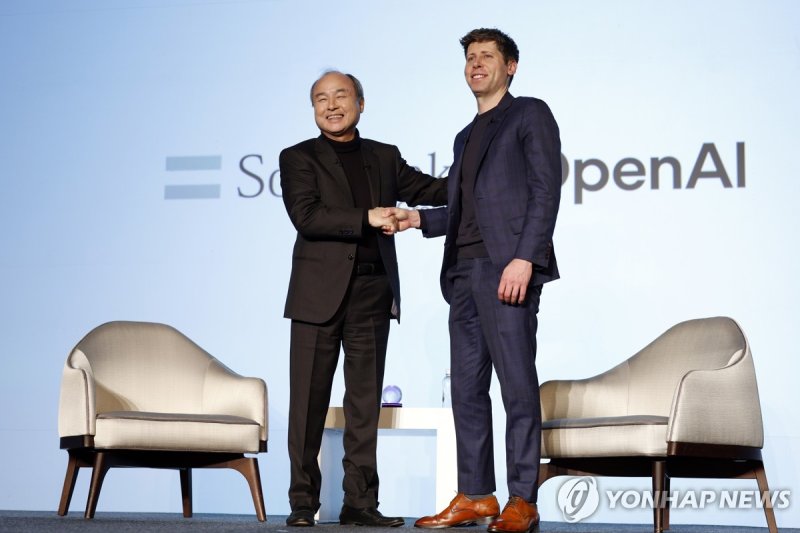
SoftBank recently announced the completion of an additional 22.5 billion USD investment in OpenAI, increasing its stake to 11% and bringing its total cumulative investment to 34.7 billion USD. This amount surpasses that of Microsoft, previously the largest shareholder.
Son expressed his alignment with OpenAI’s vision, stating, “I deeply resonate with OpenAI’s mission to bring the benefits of AGI (Artificial General Intelligence) to all of humanity.”
Sam Altman, OpenAI’s CEO, commented, “SBG’s global leadership and scale will accelerate our efforts.”
Son’s AI All-in Strategy essentially represents a full bet on OpenAI. To fund this investment, he sold shares of Nvidia and fully leveraged the unused credit line secured against shares of ARM, SoftBank’s UK semiconductor design subsidiary.
The company has mobilized all available resources to raise funds, including arranging bridge loans with banks and issuing corporate bonds to individual investors.
SoftBank CFO Yoshimitsu Goto viewed 2025 as a pivotal year for capitalizing on AI-related opportunities, noting, “This year has laid the groundwork for future assets.”
SoftBank has identified four key investment areas in AI: semiconductors, robotics, data centers, and power. Son is actively pursuing significant investments and mergers aimed at realizing Artificial Superintelligence (ASI) that surpasses human intelligence. By March next year, the expected investment amount is projected to reach 42.1 billion USD.
From Stargate to semiconductors: SoftBank’s AI investment spree
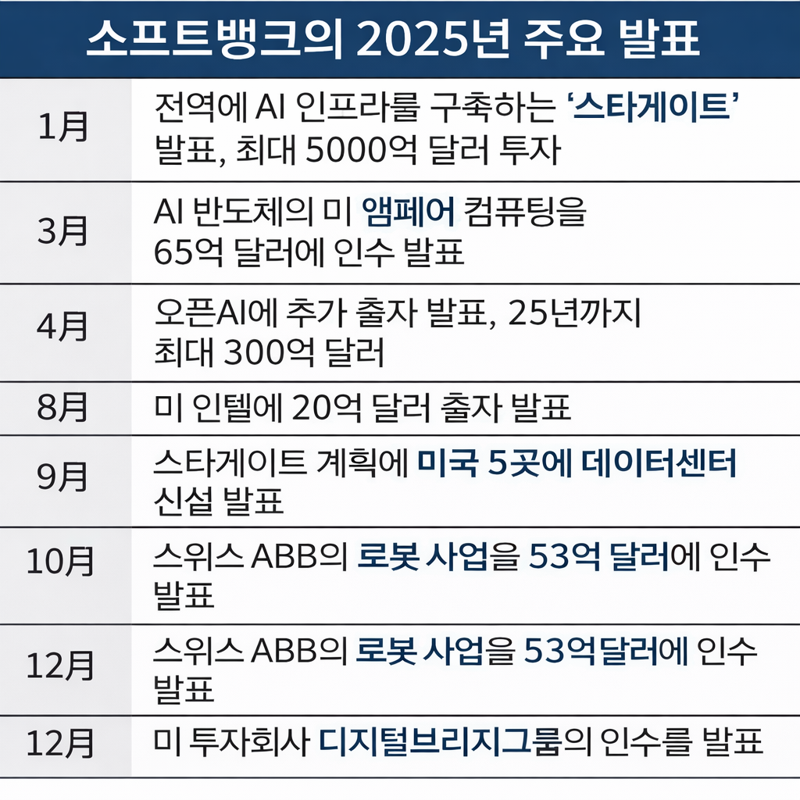
SoftBank’s AI betting began with the ambitious Stargate investment plan. Following U.S. President Donald Trump’s inauguration, Son visited the White House and announced plans to invest 500 billion USD over four years in partnership with OpenAI. SoftBank aims to construct a data center in collaboration with Texas-based SB Energy.
In March, SoftBank announced its 6.5 billion USD acquisition of Ampere Computing, a U.S. semiconductor design company with strengths in large-scale data processing and AI. This move aims to secure semiconductors for AI dedicated data centers, preparing for expanded investments with OpenAI.
In the semiconductor sector, SoftBank announced a 2 billion USD investment in Intel Corporation in August. Son expressed hope for the continued development of advanced semiconductor manufacturing and supply in the U.S., where Intel plays a crucial role. Shortly after, the U.S. government also pledged an investment of about 8.9 billion USD in Intel.
SoftBank has also laid the groundwork for expanding its Physical AI business, which focuses on autonomous operation of robots and machines. In October, the company acquired the robotics division of ABB, the global leader in industrial robotics, for 5.3 billion USD.
Son emphasized, “We will achieve a groundbreaking evolution by merging ASI and robotics to pioneer humanity’s future.”
On December 29, SoftBank announced the acquisition of U.S. investment firm Digital Bridge Group, aiming to enhance data center construction and secure computational resources needed for OpenAI’s operations.
Son dismisses AI bubble concerns, likely to continue aggressive investment
Despite the optimism, SoftBank’s close ties with OpenAI carry inherent risks. On December 30, SoftBank’s stock closed at 4,400 JPY (approximately 28.05 USD), marking a 36% drop from its October peak. Takashi Nakagawa, a senior analyst at Tokai Tokyo Intelligence, attributed this decline to “uncertainties and skepticism surrounding AI.”
Beyond the overheating of AI-related stocks, intensifying competition in AI models, as exemplified by OpenAI’s leadership, poses additional challenges. When Google unveiled its latest generative AI model, Gemini 3, in November, Altman declared a Code Red emergency, urging his team to improve functionalities. As investments in cutting-edge AI development continue, OpenAI is likely to face ongoing losses in the near term.
Nevertheless, Son firmly rejects the notion of an AI bubble. At an international finance conference in December, he dismissed concerns about overheating AI-related stocks, stating, “Those who question if AI is a bubble are misguided.”
During a June shareholder meeting, Son outlined his vision for AI business monetization, predicting, “In a decade, several companies will share approximately 600 trillion JPY (approximately 3.82 trillion USD) in profits. We aim to be among those companies.”
Nikkei speculates that Son’s AI investments are unlikely to slow down next year as he strives to position SoftBank among the elite group of AI industry leaders.