China’s trade surplus this year is about to exceed 1 trillion USD for the first time in history, prompting major countries around the world to unveil high-tariff strategies targeting China. The International Monetary Fund (IMF) and European Union (EU) have identified the undervalued yuan and overproduction as key factors distorting global trade. Mexico has joined the pressure campaign by approving substantial tariff hikes on thousands of strategic items. As the high-tariff front initiated by the Trump administration spreads from the U.S. to Europe and Latin America, international organizations have revised their growth forecasts for China upward.
IMF, EU, and Mexico Unanimously Criticize China’s Trade Practices
The IMF and EU are directly criticizing China’s currency and trade structure, intensifying regulatory measures. IMF Managing Director Kristalina Georgieva stated in Beijing on Wednesday that China’s low inflation has excessively lowered the real exchange rate, abnormally boosting export competitiveness. She added that this has deepened China’s export-dependent structure and global trade imbalances.
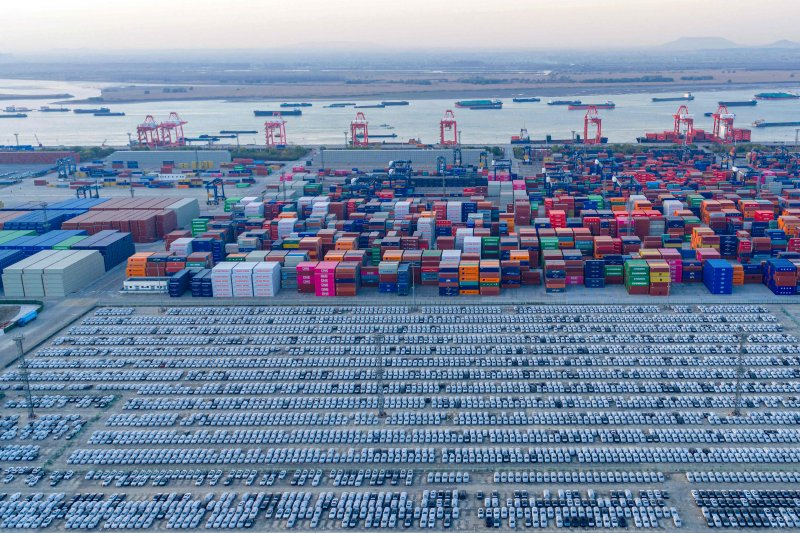
China’s trade surplus from January to November reached 1.0759 trillion USD, virtually guaranteeing an annual surplus exceeding 1 trillion USD for the first time. The IMF cautioned that China’s economic growth is merely a result of the U.S.-China tariff truce and short-term stimulus measures, and that the structural problems remain.
Warnings are also emanating from Europe. The EU Chamber of Commerce in China criticized the yuan’s 7.5% depreciation against the euro this year, its lowest level in a decade, arguing that the undervalued yuan essentially acts as an export subsidy.
French President Emmanuel Macron, following his state visit to China, told the French economic newspaper Les Échos on December 7 that if China fails to adjust its trade surplus it has built up against Europe, the EU may have no choice but to consider imposing high tariffs. Europe’s trade deficit with China is projected to reach a record 300 billion EUR (approximately 352 billion USD) this year.
This trend has spread to Latin America as well. The Mexican Senate passed an amendment to the General Import and Export Tax Law (LIGIE), allowing tariffs on 1,463 strategic items to increase from the current 0-35% to a maximum of 50%. The affected sectors, where China has a strong presence, include automobiles, machinery, steel, and plastics. While trade between China and Mexico has more than doubled over the past decade, Mexico’s trade deficit with China hit 120 billion USD last year.
South Korea is also feeling the impact. By the third quarter of this year, South Korea’s trade surplus with Mexico reached 12.098 billion USD, with many of its major export items overlapping with those targeted by the new tariffs. South Korea and Mexico have only signed an investment protection agreement and lack a free trade agreement that could provide tariff protection. Some analysts view Mexico’s recent decision as a strategic move to distance itself from China and enhance its negotiating power with the Trump administration ahead of the United States-Mexico-Canada Agreement (USMCA) review.
China’s Growth Rate Revised Upward Amid Export Recovery
Recently, international financial institutions including the World Bank (WB), IMF, Organization for Economic Co-operation and Development (OECD), and Asian Development Bank (ADB) have all raised their growth forecasts for China. Analysts attribute this adjustment to the effects of short-term stimulus measures, rebounding exports, improvements in manufacturing and infrastructure productivity, and sustained global demand.
On Thursday, the World Bank projected China’s growth rate for this year at 4.9%, up 0.4 percentage points from previous estimates. They cited expansionary fiscal and monetary policies supporting consumption and investment, along with continued demand from developing countries that led to exports being stronger than expected.
The IMF had previously raised its forecast for this year by 0.2 percentage points to 5.0% and its projection for next year by 0.3 percentage points to 4.5%. The IMF emphasized that while the Chinese government’s macroeconomic stimulus has temporarily boosted growth, it fails to address weak domestic demand, limiting its long-term effectiveness.
The OECD also raised its forecast earlier this month by 0.1 percentage points to 5.0%, while the ADB increased its estimate to 4.8%. Both organizations noted that the recovery in exports and the effects of policy support have been reflected in real economic indicators.