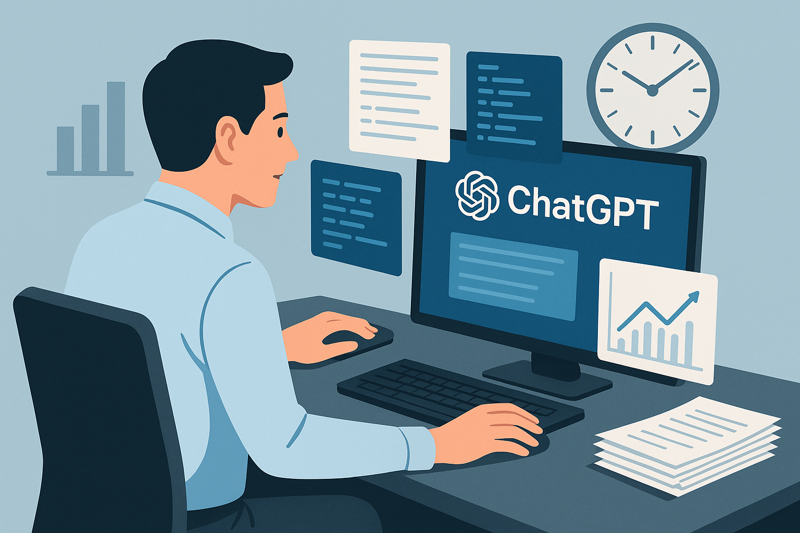
OpenAI, the developer of ChatGPT, claims that businesses can reduce daily working time by about an hour per employee by leveraging artificial intelligence (AI). Amid ongoing debates about AI’s effectiveness in the workplace, the company presented productivity gains based on actual usage data from corporate users.
In a report titled “The State of Enterprise AI” released on Monday, OpenAI surveyed about 9,000 AI users across roughly 100 companies. The findings revealed that 75% of respondents reported improvements in both work speed and quality due to AI adoption. Users of ChatGPT Enterprise, the company’s business-oriented service, reported saving an average of 40 to 60 minutes per day.
The time-saving benefits were even more pronounced in certain fields such as data science, engineering, and communications. OpenAI noted that professionals in these areas saved between 60 to 80 minutes daily, with some users reporting weekly time savings of over 10 hours. Beyond reducing repetitive tasks, AI also helped accelerate traditionally time-consuming activities like data analysis and coding.
OpenAI reported an eightfold increase in ChatGPT conversations compared to the previous year, with the usage of “reasoning” tokens for solving complex problems surging by roughly 320 times. This trend suggests that companies are rapidly expanding their use of AI beyond basic queries to tackle more sophisticated challenges.
Anthropic, a competitor in the AI field, released similar findings. After analyzing 100,000 conversations with its chatbot Claude, the company reported that AI usage cut task completion times by 80%. Anthropic projects that AI could boost U.S. labor productivity growth by 1.8 percentage points annually over the next decade.
However, these corporate reports have faced skepticism, with critics arguing that they may overstate AI’s benefits, particularly given their reliance on internal data.
Contrasting these optimistic outlooks, MIT researchers found in August that most companies investing in generative AI projects failed to see concrete returns. Similarly, a September report from Harvard and Stanford researchers dismissed a significant portion of AI-generated output as “meaningless workslop.”
Addressing these conflicting views, OpenAI’s Chief Operating Officer Brad Lightcap acknowledged the divergent research findings but maintained that they don’t align with the trends observed in real-world applications. He emphasized that business adoption of AI is accelerating rapidly, mirroring trends in the consumer market.
OpenAI’s Chief Economist, Ronnie Chatterji, a professor at Duke University, added that three out of four users report being able to perform tasks previously beyond their capabilities. Chatterji stressed the importance of recognizing these structural changes in work processes when evaluating AI’s influence.