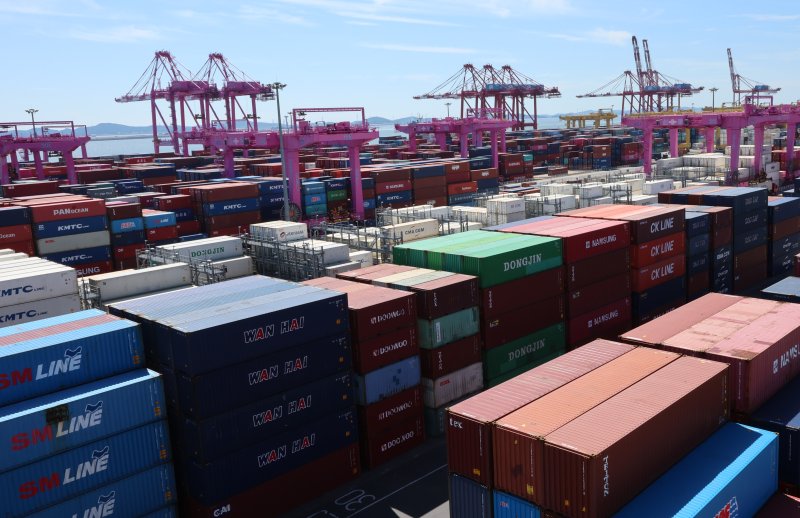
It is projected that South Korea’s exports will surpass 700 billion USD for the first time in history this year, propelled by robust demand for semiconductors and ships. Experts predict this upward trajectory will continue into next year, fueled by strong IT sector exports such as semiconductors and a diversification of the automotive export market, which had previously experienced a sharp decline.
According to a report released on Friday by the Korea International Trade Association (KITA) titled “2025 Export and Import Evaluation and 2026 Outlook,” this year’s exports are projected to reach 704 billion USD, a 3.0% increase from last year. Imports are expected to decrease slightly by 0.3% to 630 billion USD, resulting in a trade surplus of 74 billion USD.
Semiconductors and Ships Propel Exports to Historic 700 BillionUSD Milestone
The KITA report identifies semiconductors and ships as the key drivers behind this unprecedented achievement.
The semiconductor sector, in particular, is expected to post record-high performance this year, driven by surging demand for next-generation chips like high-bandwidth memory (HBM) for artificial intelligence (AI) applications. Limited production capacity has led to soaring prices, further boosting the sector’s performance.
In the shipbuilding industry, the delivery of high-value vessels, including LNG carriers, ordered during 2022 and 2023 is anticipated to push export growth beyond 22% this year.
The automotive sector, which had seen a sharp decline in exports to the U.S. due to tariffs, is showing signs of recovery as manufacturers diversify their markets, particularly towards the European Union (EU) and other regions.
The report notes that expectations of reduced tariffs following recent U.S.-Korea negotiations contributed to a rebound in exports to the U.S. in November, a trend likely to continue through year-end. However, steel exports, facing a 50% tariff, and oil products, hit by falling prices, are expected to remain weak through the end of the year.
Export Growth Projected to Continue Next Year
Despite global economic uncertainties, analysts expect South Korea to maintain positive export growth in the coming year.
For 2026, exports are forecast to increase by 1.0% to 711 billion USD, while imports are projected to rise by 0.5% to 633 billion USD, resulting in a trade surplus of 78 billion USD.
The report suggested that IT products, especially semiconductors, SSDs, and wireless communication devices, will likely continue to show strong growth next year.
The semiconductor market is expected to maintain stable pricing due to ongoing AI demand and supply constraints. The SSD market is anticipated to see growth in exports, particularly in the enterprise sector, driven by increasing demand for high-capacity storage in AI infrastructure.
Wireless communication devices are also expected to see modest growth, supported by the rising popularity of foldable smartphones and subsequent increases in device prices.
In contrast, the automotive sector is projected to experience a slight 1.0% decline compared to this year, due to base effects and gradual increases in U.S. local production.
Oil product exports are forecast to decrease by 13.3% as prices fall to the mid-50 USD range, while the petrochemical sector may see a 6.1% decline in exports due to ongoing supply surpluses and significant capacity additions in China.
Steel exports are also expected to decline by 2.0%, hampered by high U.S. tariffs, stagnant global demand, and rising protectionist policies worldwide.
Next year’s imports are likely to decrease due to falling international oil prices. However, potential production cuts by oil-exporting countries and increased imports of semiconductors and manufacturing equipment may help stabilize overall import levels.
Jang Sang-sik, Head of KITA’s International Trade and Commerce Research Institute, stated, “We expect IT products, particularly semiconductors, to drive our export growth next year, buoyed by strong AI demand. The recent U.S.-Korea negotiations have significantly improved conditions for exports to the U.S.”
Jang emphasized the need to diversify export markets towards regions such as the Middle East and ASEAN, given the limited growth in global trade and complex uncertainties ahead. He suggested that South Korea should continue to expand its export base, with a focus on K-content and consumer goods.